
Connect your WhatsApp number连接你的 WhatsApp 号码
Pair the number families already message you on, so every enquiry lands in the system instead of on somebody's phone.把家长本来就在用的号码接进系统,让每一则询问都落在系统里,而不是某个人的手机里。
这篇指南的正文目前只有英文版。标题、摘要与导览已翻译;内文仍在翻译中。
Enquiries arrive on WhatsApp. Connecting the number means they arrive in Hull too — visible to the whole team, attached to a contact, and answerable by the assistant when nobody is at the desk.
It is your ordinary WhatsApp number. Nothing is migrated and nothing changes for the person messaging you.
1. Open Connections
Marketing → Connections — the megaphone in the top bar.
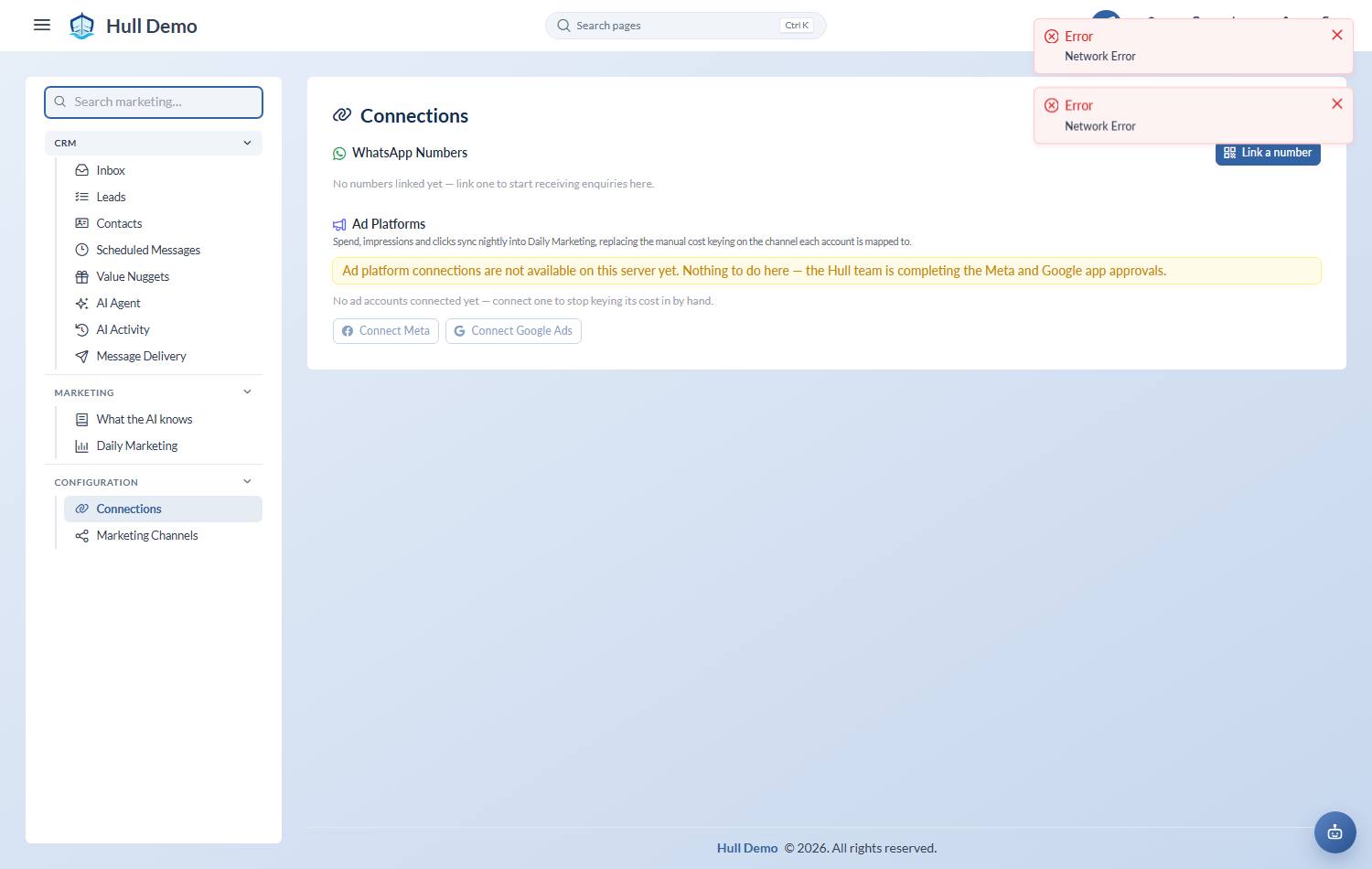
2. Add the number and scan the code
Add the number you want to connect. A QR code appears.
On the phone that owns that WhatsApp number: open WhatsApp → Linked devices → Link a device, and scan the code on your screen.
This is the same pairing WhatsApp Web uses. Hull becomes another linked device on that account.
Re-linking a number you removed
If you delete a number and pair it again later, the old conversations come back to it. The moment the new connection reports which number it is, any earlier record of that number hands its conversations over and retires, so you get one history rather than the same customer sitting in two inboxes.
3. Check the status
The number shows as connected once pairing finishes, with a last-seen time. From then on, messages flow into Inbox.
4. Say what the number is for
Each number carries a line type, and it decides whether new chats on it count as enquiries:
- Enquiry line — the number you advertise. New customers messaging it count.
- Branch line — a branch's everyday number. Nothing counts by default.
- Unclassified — not decided, and nothing counts.
5. Assign it to a branch (optional, but do it if you have several)
Each number can belong to a branch. Once it does, staff who run that branch — branch admins and heads — see only that branch's conversations. Owners and marketers keep seeing everything.
A number you leave unassigned stays visible to everyone, which is the safe default: nothing hides because somebody forgot a setting.
Whether the assistant answers is decided here, and only here
Each number carries its own AI auto-reply setting, beside its line type:
| Off | The assistant never answers on this line |
| Suggest | It drafts, a person sends |
| Auto-reply | It answers by itself |
This is the setting most academies were missing: the enquiry line you advertise should answer at nine at night, and a branch's everyday number — where existing parents ask about a reschedule — usually should not.
Changes here need Save. The page does not write as you click, so you can set a line's type and its AI setting together and commit them once.
Why there used to be two, and why that was a problem
There was an academy-wide switch as well as this one. On 30 September a school set the academy switch off and its line went on replying — correctly, because the number's own setting is meant to win. But the switch they had just used looked like the master control, and for six minutes they believed the assistant was silent when it was not.
Two controls for one behaviour is the fault, whichever way round they resolve. There is one now.
Pausing and resuming
- Disconnect stops the number without unpairing it. The socket closes; the pairing is kept. Use it while you sort something out.
- Reconnect resumes a disconnected number — no new QR needed. It only asks for a fresh code if the number was logged out from the phone.
What to expect once it is live
- Every incoming message is kept, including ones that arrive while you are closed.
- Messages from an ad click carry their source, so you can see which campaign produced the conversation without asking.
- Photos and files are stored, though the assistant does not try to read them — anything with an attachment is left for a human.
- You can still reply from your phone. Hull is a linked device, not a replacement; it records what was said either way — and a reply you send from the handset stands the assistant down on that conversation, exactly as one typed in the inbox would.
- If someone links the same number somewhere else, Hull steps aside rather than fighting over the connection. Reconnect from this page when you want it back.
The name you see for a contact
A contact shows under the name your school saved for them on that number — the one in your own phone's address book, not whatever they chose as a WhatsApp display name. That is usually the name your staff recognise.
It is per number, deliberately: the same person can be saved differently on the enquiry line and a branch line, and each inbox shows its own.
Did the message actually arrive?
Marketing → Message Delivery. A tick in the inbox only ever meant WhatsApp accepted the message from us — not that the family's phone got it. This page is the difference, and the failure it exists to end is a specific one: the parent never received the reply, the inbox looked fine, and the first anybody knew was the parent asking again three days later.
Each message shows one word:
| Sending | queued here, not handed over yet |
| Sent | WhatsApp took it, no receipt back yet |
| Delivered | it reached their phone |
| Read | they opened it |
| Undelivered | sent, but no receipt after several minutes — treat as not arrived |
| Failed | it did not go |
Undelivered is the one to act on. It usually means the recipient's phone cannot decrypt messages from this connection — the family sees "Waiting for this message" on their side. Reconnecting the number generally clears it. Ring the family if it mattered; do not assume a resend fixes it by itself.
The page also shows whether each number is connected at all, and the counts over the last stretch, so you can tell one bad afternoon from something getting steadily worse.
Related: Work the WhatsApp inbox · Set up the AI agent.